
























7 Smart Warehouse Technologies to Implement in 2026


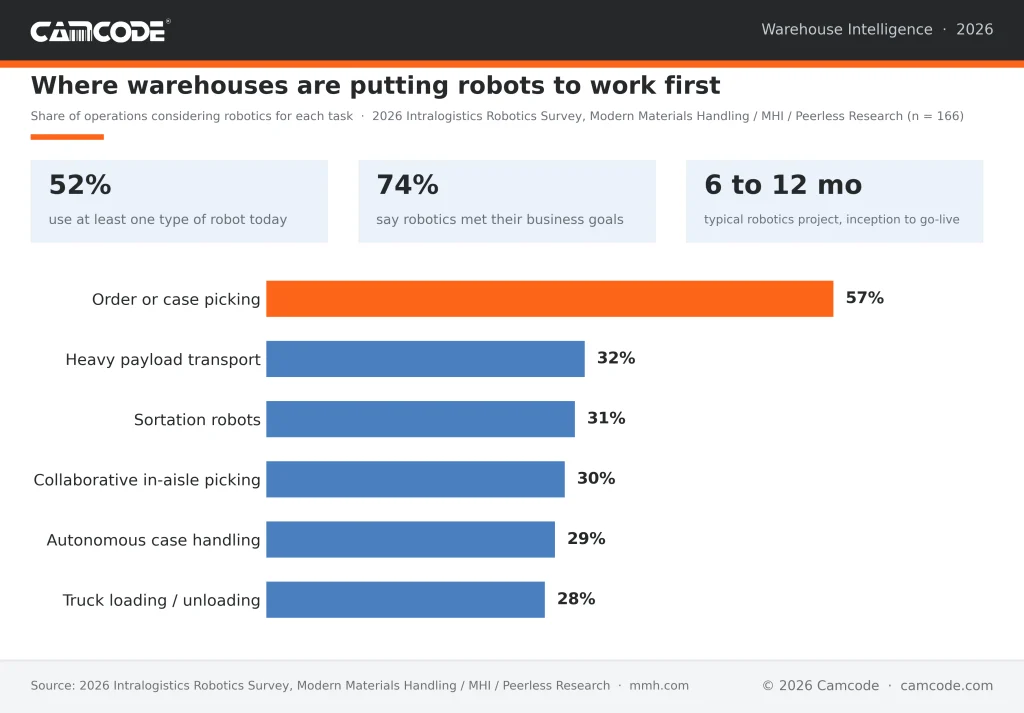
Smart warehouse technologies are no longer a pilot project: 52% of warehouse operations run at least one type of robot and only 3% have no robotics plans, per the 2026 Intralogistics Robotics Survey (Modern Materials Handling and MHI).
Smart warehouse technology is the group of automated systems, including warehouse management software, AS/RS, AGVs and AMRs, cobots, IoT sensors and automated picking tools, that move, store, pick and track inventory while updating stock data in real time. The seven smart warehouse technologies below have the strongest track record, and each entry covers what it does, current adoption data and when it is the right choice.
Smart warehouse technologies are any automated systems that moves, stores, picks or tracks inventory and reports the result to a warehouse management system in real time.
Smart warehousing systems fall into seven groups:
A smart warehouse combines several of these so that inventory location, order status and labor activity are visible without a manual count. In the 2026 MHI Annual Industry Report, 35% of supply chain organizations said they already use robotics and automation and 38% plan to within five years.
John Paxton, CEO of MHI, framed the shift this way when the 2026 Annual Industry Report was released:
“Supply chains can no longer be optimized at the edges. They must be rewired end-to-end. Only connected, intelligent, and automated real-time networks will withstand the volatility and meet the future customer demands for speed and efficiency.”
– John Paxton, CEO, MHI. Business Wire, April 2026
Each of the seven technologies below is one piece of that connected network, and the order you add them in matters.
A traditional warehouse depends on people walking to inventory, paper or handheld pick lists and periodic physical counts. A smart warehouse brings inventory to the picker with robots or AS/RS, confirms every pick with a barcode scan, voice prompt or light, and updates stock levels in the WMS the moment a unit moves.
The practical differences show up in three places: picking accuracy, labor hours per order and inventory visibility. Robotics projects also move faster than conventional automation: 48% of respondents to the 2026 Intralogistics Robotics Survey completed their initiative in 7 to 12 months and 13% in six months or less.
 ■CAMCODE
Smart vs. traditional warehouse
| Process | Traditional warehouse | Smart warehouse |
|---|---|---|
| Receiving | Manual count against the packing slip | Dock-door RFID or barcode scan posts receipts to the WMS on arrival RFID / barcode |
| Putaway | Worker chooses a slot from memory | WMS directs the slot; AGV or AS/RS moves the pallet WMS + AGV / AS/RS |
| Picking | Paper or handheld list, picker walks to every slot | Pick-to-light, voice or AMR brings work to the picker; every pick confirmed by scan Picking tools + AMR |
| Inventory count | Quarterly or annual physical count | Continuous cycle count from scans, RFID reads and sensors RFID + IoT |
| Reporting | End-of-day or end-of-week | Real-time dashboards from the WMS and IoT feeds WMS + IoT |
The seven smart warehouse technologies below are ordered by how quickly most operations can put them to work: automated picking tools and AGVs first because they slot into an existing building, inventory control and the WMS next because everything else reports to them, then IoT, cobots and AS/RS as the investment and floor changes grow.
Each entry covers what the technology does, what has to be in place before it goes live and the latest adoption data from the 2026 Intralogistics Robotics Survey, Interact Analysis and Zebra. Every one of them reads a barcode or RFID label thousands of times a day, which is why the labeling checklist sits between the first two.
Pick-to-light, voice picking and robotic order picking are the three automated picking tools that deliver ROI fastest, because order picking consumes the largest share of warehouse labor hours.
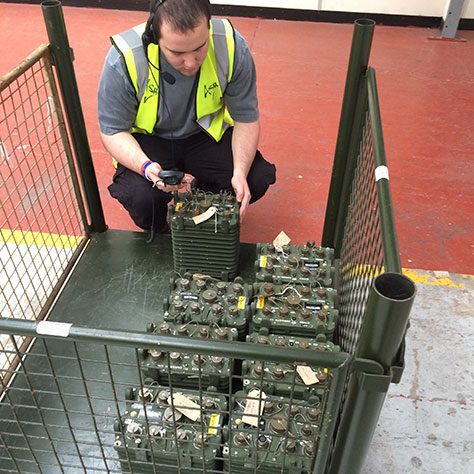
All three confirm picks against barcode labels on racks, bins and products, so a durable labeling system is the prerequisite that every picking ROI calculation depends on (our step-by-step guide to implementing barcodes in a warehouse covers the label, scanner and WMS setup). Order and case picking is the top robotics use case under consideration, cited by 57% of respondents to the 2026 Intralogistics Robotics Survey.
Automated guided vehicles (AGVs) move pallets, racks and containers along fixed routes marked by magnetic tape, wire or floor markers, while autonomous mobile robots (AMRs) navigate with onboard sensors and reroute around obstacles. AGVs remain the better choice for repetitive long-haul moves between receiving, storage and shipping, and autonomous forklifts are the fastest-growing part of the category by revenue.
Interact Analysis projects the mobile robot market will grow from $5 billion in 2024 to $14 billion by 2030, at 19% a year, while fixed automation grows 2.4%. Prerequisites are a WMS or warehouse execution system to send transport orders, clear floor markings, charging stations and location labels the vehicles can read, and AGVs can automate the entire receiving process when paired with dock-door scanning.
Ash Sharma, VP of research for robotics and warehouse automation at Interact Analysis, explained why forklifts dominate the revenue side:
“Despite lower shipment share, forklifts generate the highest revenues due to premium pricing. By 2030, forklifts are projected to deliver roughly 33% of total mobile robot revenue, while contributing only 14% of shipments.”
– Ash Sharma, VP Research, Robotics and Warehouse Automation, Interact Analysis. January 2026
For a mid-sized warehouse that means the first AGV purchase is usually a pallet mover or autonomous forklift, not a fleet of small robots.
Automated inventory control platforms count stock continuously instead of once a quarter. RFID readers at dock doors and on forklifts, fixed barcode scanners on conveyors and cycle-count drones or robots feed a live count into the WMS, which flags variances the same day.
The platform is only as accurate as the identifiers on the inventory, so durable inventory tags and rack labels come first; if you are weighing RFID against barcodes for this job, see the pros and cons of RFID for inventory management. In Zebra’s 2025 Warehousing Vision Study, 63% of warehouse leaders said they plan to implement AI software and augmented reality within five years, and 64% plan to increase spending on warehouse modernization.
A warehouse management system (WMS) is the software layer every other smart warehouse technology reports to. It holds inventory locations, directs putaway and picking, assigns labor and shares order status with carriers and customers, which is the core of day-to-day warehouse management.
A warehouse execution system (WES) or warehouse control system (WCS) sits between the WMS and the equipment, dispatching work to conveyors, sorters, AS/RS and robots in real time (here is how a WCS differs from a WMS). A WMS is the prerequisite for AGVs, AMRs, AS/RS and automated picking, because each of those systems needs an order source and a place to write back what it did.
The Internet of Things (IoT) in a warehouse is the network of sensors, RFID readers, wearables and connected equipment that reports location, temperature, movement and status without a person scanning anything. Typical deployments include dock-door RFID portals that receive pallets automatically, forklift telematics that log utilization and impacts, and temperature sensors in cold storage that alert before product is lost.
In Zebra’s 2025 Warehousing Vision Study, 93% of warehouse associates said automation and mobile technology would help attract and retain workers, and 88% called collaborative robots important for solving workplace issues.
Collaborative robots (cobots) work alongside associates rather than replacing them, which keeps infrastructure changes small. Warehouses began embracing collaborative robots for exactly that reason, and the common form today is a collaborative picking AMR that meets a picker in the aisle, receives items and carries the tote to packing, so the picker stops walking.
Cobots integrate with the WMS through an API or the robot vendor’s fleet software, need Wi-Fi coverage and charging stations, and usually go live in six to twelve months. Interact Analysis reported cobot shipments grew 14.5% in 2025 to about 57,000 units and forecasts 17.3% annual growth through 2030, with logistics automation as one of the main drivers.
Automated storage and retrieval systems (AS/RS) store inventory in dense racking, shuttles, carousels or vertical lift modules and deliver it to a workstation on demand. Modern AS/RS is modular, so an operation can start with a few vertical lift modules and add capacity later instead of committing to a fixed crane system.
The trade-off is up-front cost against floor space, labor and accuracy, and Conveyco’s rundown of the pros and cons of AS/RS is a fair summary of both sides. AS/RS remains one of the most common forms of intralogistics automation: 58% of respondents to the 2026 Intralogistics Robotics Survey use or are considering conveyors, sortation, AS/RS or shuttle systems.
Pick-to-light, cobots and AGVs solve different problems, so the ROI comparison depends on where your labor goes.
Across all three, 74% of completed robotics projects met their business goals.
Choose smart warehouse technology by matching the system to the constraint that costs you the most.
Every option depends on a WMS and a clean labeling system, so those two come first regardless of which technology you buy.
●CAMCODE
Interactive tool
Each answer adds points to one or more of the seven technologies. The main cost you name carries the most weight (up to 5 points), then building constraints, budget, order volume and labeling maturity. If you have no WMS, the tool always places the WMS first because AGVs, AS/RS and picking robots need it as their order source. Adoption and timeline figures come from the 2026 Intralogistics Robotics Survey (Modern Materials Handling, MHI and Peerless Research Group, n = 166), Interact Analysis mobile robot forecast (January 2026), Interact Analysis cobot forecast (May 2026), Zebra Warehousing Vision Study (February 2025) and the 2026 MHI Annual Industry Report. Scores are internally derived from your answers and are a starting point, not an engineering assessment.
Smart warehouse technology is priced three ways:
In the 2026 Intralogistics Robotics Survey, 36% of respondents preferred a hybrid CapEx and OpEx model, 36% preferred pure CapEx and 29% favored RaaS. Budgets are rising: 45% reported larger robotics budgets this year and 18% expected increases above 10%.
Implementation timelines are shorter than fixed automation. A typical robotics initiative takes six to twelve months from inception to go-live, with 17% of projects operational in under a year. Returns track well: 74% of respondents said robotics met their business goals and 94% said speed to productivity met or beat expectations.
Dwight Klappich, the former Gartner VP analyst who reviews the survey each year, put the timeline plainly:
"A typical robotic initiative is six to 12 months from inception to go live, which is significantly less than conventional automation." - Dwight Klappich, Principal, DK Advascent (former VP Analyst and Fellow, Gartner). Modern Materials Handling, June 2026
That window assumes the WMS and labeling are already in place; add three to six months if they are not.
Smart warehouse technology is not a single purchase. It is a stack: a WMS to hold the orders, labels the equipment can read, then whichever of the seven systems above attacks your biggest cost first.
Most operations start with automated picking tools or AGVs because they fit an existing building and go live in six to twelve months, then add inventory control, IoT, cobots and AS/RS as the budget and the floor allow.
You do not need a full overhaul to get there. Pick one bottleneck, fix it, measure it and move to the next. Whichever system you choose, it will scan your rack labels, bin labels and inventory tags thousands of times a day, so make those durable enough to outlast the technology they serve.
Smart warehouse technology is any automated system that moves, stores, picks or tracks inventory and reports the result to a warehouse management system in real time. The seven main types are warehouse management systems, automated storage and retrieval systems, AGVs and AMRs, collaborative robots, IoT sensors and RFID, automated inventory control platforms and automated picking tools.
In the 2026 MHI Annual Industry Report, 35% of supply chain organizations already use robotics and automation.
Start with the WMS and a durable labeling system, because every other smart warehouse technology needs an order source and scannable identifiers. After that, pick the technology that attacks your largest cost: automated picking tools for picking labor, AS/RS for floor space, AGVs or AMRs for travel time and RFID with an automated inventory control platform for count accuracy.
A typical robotics initiative takes six to twelve months from inception to go-live. In the 2026 Intralogistics Robotics Survey, 48% of completed projects took 7 to 12 months, 13% took six months or less and 26% took 13 to 18 months. Fixed automation such as a large AS/RS usually takes longer.
Three ways:
In the 2026 Intralogistics Robotics Survey, 36% of respondents preferred a hybrid CapEx and OpEx model, 36% pure CapEx and 29% RaaS. 45% of respondents reported a larger robotics budget than the year before.
A traditional warehouse relies on people walking to inventory, paper or handheld pick lists and periodic physical counts.
Whereas, a smart warehouse brings inventory to the picker with robots or AS/RS, confirms every pick by scan, voice or light and updates the WMS the moment a unit moves, so inventory location, order status and labor activity are visible without a manual count.
Our sales engineers are experts in automatic asset tracking, tagging and identification, and can answer all your questions. Get in touch now.
Lets Talk ›Enter your information and get a free checklist of the top questions to answer and tips to plan a successful asset tagging project for any warehouse management system implementation.