



















RFID for Inventory Management: Pros, Cons and Cost


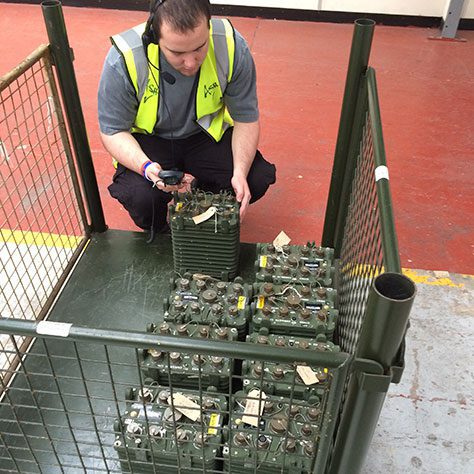
RFID for inventory management uses radio waves to identify and count tagged items automatically, with no line-of-sight scan. A reader picks up hundreds of RFID tags in seconds and sends each item ID to your inventory management system, so a count that took a shift with a barcode scanner takes minutes.
In a 2018 study by the Auburn University RFID Lab and GS1 US, item-level RFID raised inventory accuracy from 63% to 95% and cut cycle count time by 96%.
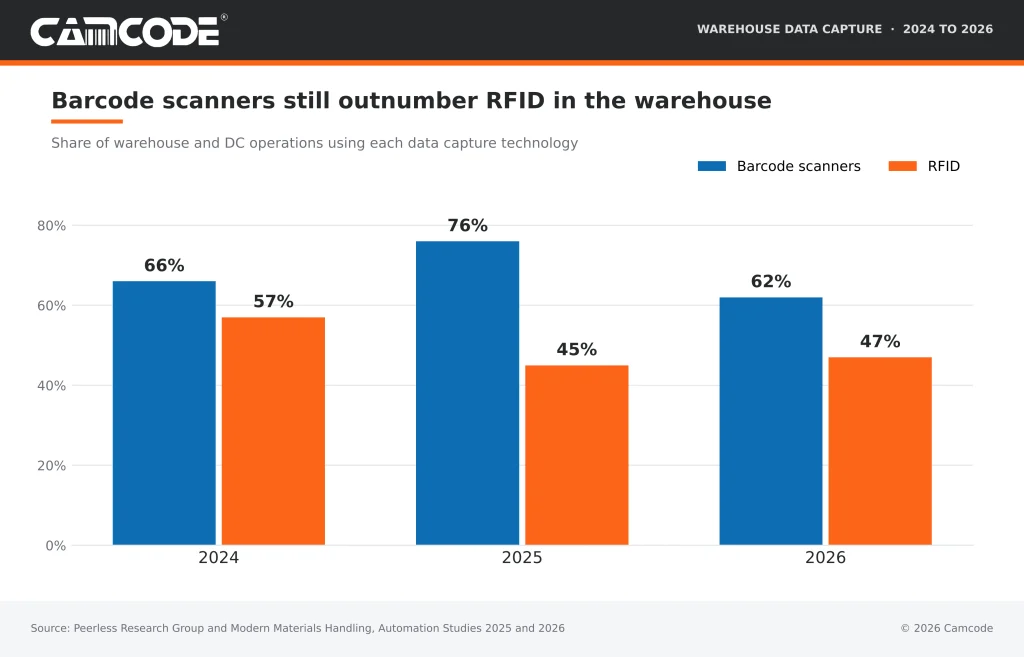
Those gains come with real costs: readers, tags, software integration and radio interference from metal and liquids. That is why barcodes remain the default in most facilities. In the 2026 Automation Study from Peerless Research Group and Modern Materials Handling, 62% of warehouse operations use barcode scanners and 47% use RFID.
This guide covers how RFID inventory management works, its pros and cons, what an RFID inventory system costs and when barcode labels are the better choice.
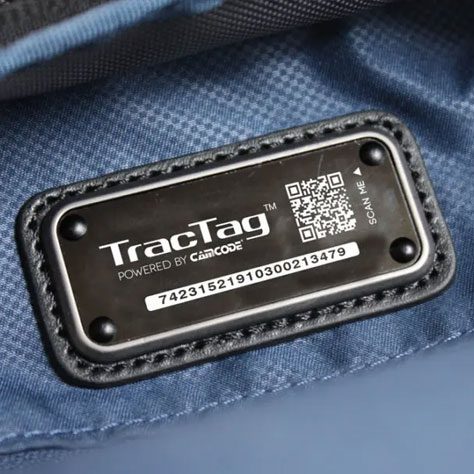
The use of RFID for inventory management requires a reader that uses radio waves to communicate with an RFID tag. Each tag holds a microchip and an antenna. The chip stores a unique ID that the reader captures and, on many tags, data the reader can rewrite in place. The tag is built into a paper or plastic label or a rugged housing, then attached to an item, case or pallet.
For the underlying technology, see our explainer on radio-frequency identification.
When it comes to using RFID for inventory management, there are two different types of tags you can use.
RFID works in a warehouse by reading tagged cases, pallets and items automatically at each point where inventory moves, then updating the warehouse management system without a manual scan. The workflow is the same for passive and active systems and has four steps:
Justin Patton, who directs the Auburn University RFID Lab, puts the speed advantage this way:
“Recording literally hundreds of items in just seconds”
– Justin Patton, Director, Auburn University RFID Lab. Auburn University via PR Newswire, October 2022
RFID tells you what is in a zone. It does not replace the location system. Racks, bins and dock doors still need durable warehouse rack labels so people and scanners can confirm exactly where each item belongs.
For the full process, see our guide to warehouse inventory tracking.
RFID for inventory management has four main benefits: higher inventory accuracy, faster counting, lower labor per count and better tracking of returnable assets.
The main disadvantages of using RFID for inventory management are cost, interference from metal and liquids, infrastructure demands, limited phone support and security exposure.
RFID is the better choice when you need to count large volumes of items quickly without handling each one. For most companies that want an accurate, low-cost and easy-to-run system for inventory management, barcode labels remain the better starting point, as our barcodes vs. RFID comparison explains.
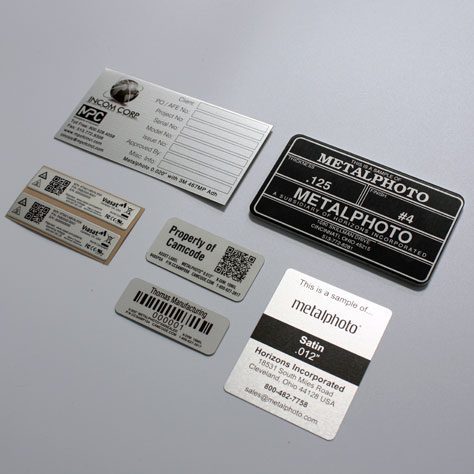
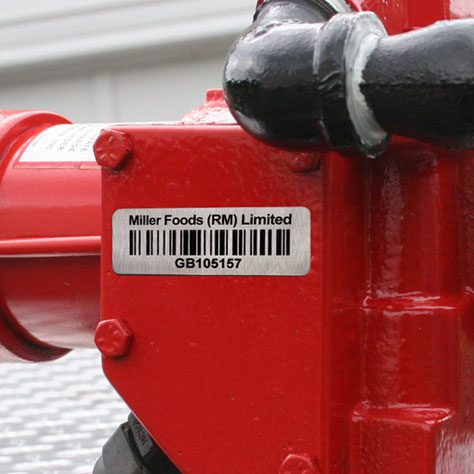
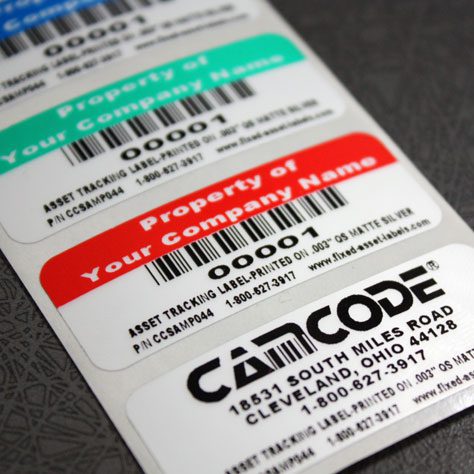
Some barcode labels, such as Camcode’s Metalphoto® inventory tags, are durable enough to withstand harsh indoor and outdoor environments and resist chemicals, solvents and abrasion.
CAMCODE| Factor | Barcode labels | Passive RFID tags |
|---|---|---|
| How it reads | Optical scan of one label at a time, with line of sight | Radio read of many tags at once, with no line of sight |
| Read range | Close range, limited by the scanner optics | Up to about 12 m for passive UHF (Camcode RFID guide) |
| Counting speed | One scan per item | Up to 1,200 tags per second (GS1 US) |
| Label or tag cost | $0.01 to $0.05 per standard label (CPCON) | $0.04 to $0.25 per label or inlay (RedBeam) |
| Reader hardware | Any smartphone or a basic handheld scanner | Dedicated readers: $1,000 to $4,000 fixed and $1,500 to $3,000 handheld (RedBeam) |
| Metal and liquids | Reads on any surface | Needs on-metal tags at $0.75 to $5.00 each (RedBeam) |
| Data security | Readable only with line of sight to the label | Readable by radio, so unprotected tags can be copied |
| Best for | Most inventory and asset tracking, small and mid-size operations and harsh environments | High-volume counts, item-level retail, returnable assets and dock-door automation |
A barcode scan is as accurate as an RFID read and often more certain, because the operator confirms each item. Barcodes can also be applied to any surface, including metal, without affecting read performance.
RFID is different. Metal can block a tag signal and liquid can absorb it, so tagging those items takes a special on-metal tag that adds to the overall cost.
Many operations use both. Camcode RFID labels carry an RFID inlay plus a printed barcode and a human-readable number, so an item can still be identified if a tag fails or no RFID reader is nearby. If you are starting from scratch, a warehouse barcode system is the faster and cheaper first step. RFID can be added later where bulk counting justifies it.
An RFID inventory system costs roughly $5,000 to $25,000 in the first year for a single-site pilot and $100,000 or more for an enterprise rollout, according to RedBeam. The total cost of an RFID system implementation has four parts: tags, reader hardware, software and integration.
CAMCODE| Cost item | Typical range | What moves the price |
|---|---|---|
| Passive RFID labels and inlays | $0.04 to $0.25 per tag | Order volume: $0.15 to $0.25 at about 1,000 tags and $0.04 to $0.07 at 100,000 or more |
| On-metal passive tags | $0.75 to $5.00 per tag | Needed on steel racks, machinery and metal containers |
| Active tags | $15 to $50+ per tag | Battery replacement adds $3 to $7 per tag every 2 to 5 years |
| Fixed readers | $1,000 to $4,000 each | One per dock door, conveyor or storage zone |
| Handheld readers | $1,500 to $3,000 each | One per counting team |
| Antennas | $150 to $300 each | Several per fixed reader |
| RFID printers and encoders | $1,500 to $6,000 | Only if you print and encode tags in-house |
| Software | $100 to $3,500+ per month | Basic tracking at the low end, ERP integration at the high end |
| Integration and deployment | $2,000 to $25,000+ | Number of sites and systems to connect |
| Recurring costs | 15 to 25% of first-year spend per year | Software, reader upkeep and replacement of 5 to 15% of passive tags |
Tags are the smallest line in most passive systems. McKinsey reports that the average tag price fell 80% in a decade to about four cents. The bigger costs are read points and software. Each dock door or zone needs a reader, antennas, cabling and power. The data also has to flow into your inventory or warehouse management system.
Active RFID reverses the math. Tags cost $15 to $50 or more each and need battery replacement, so active systems fit a few hundred high-value assets, not thousands of inventory items.
Budget for recurring costs too. RedBeam puts them at 15 to 25% of first-year spend each year for software, reader upkeep and replacement tags. A barcode program avoids most of this: labels cost pennies and staff can scan with the phones they already carry.
Yes. RFID increases inventory accuracy from about 63% to 95% at the item level, according to the Auburn University RFID Lab and GS1 US. The same study found that brands and retailers using RFID to check shipments reached 99.9% order accuracy, while 69% of orders checked without it contained data errors.
Bill Hardgrave, who founded the RFID Lab, described poor inventory accuracy in the study announcement as:
“A preventable problem that can be solved with greater automation through RFID”
– Bill Hardgrave, Provost, Auburn University and founder of the RFID Lab. DC Velocity, November 2018
Earlier results were more modest. A University of Arkansas study of case-level tagging found RFID could improve inventory accuracy by about 13% over manual methods.
The gain is largest in retail, where store counts drift quickly. In a warehouse that already scans barcodes at every move and runs regular cycle counts, the starting point is higher and the gain is smaller, so the implementation cost may outweigh it. Compare established options such as barcode labels and tags designed for inventory control against RFID before you commit.
Retail is the largest example of RFID in inventory management, followed by logistics, warehousing and healthcare.
Aileen Ryan, president and CEO of the RAIN Alliance, reported in April 2026:
“Growing adoption of RAIN RFID in existing markets such as retail, logistics, healthcare and manufacturing”
– Aileen Ryan, President and CEO, RAIN Alliance. RAIN Alliance, April 2026
Most of these programs tag at the source and count with handheld readers first. Fixed infrastructure comes later.
An RFID inventory system pays off when the labor saved on counting is worth more than the readers, tags and integration. It tends to fit when:
Barcode labels usually fit better when:
Small businesses rarely need fixed readers. A pilot with one handheld reader and a few thousand tags tests the case before you wire dock doors. When you are ready, follow our 5 steps to building an RFID tracking system.
RFID for inventory management does one thing better than any other method: it counts large volumes of tagged items in seconds, with no line of sight. That speed is what lifts inventory accuracy from about 63% to 95% in retail and takes most of the labor out of a cycle count.
It also costs more than barcodes, needs readers and software integration and reads poorly on metal and liquids without special tags. For most operations the practical answer is to start with durable barcode labels, then add RFID at the points where bulk counting pays for the hardware. Camcode makes both, so you can match the asset tracking labels and tags to each job.
A common example is item-level tagging in retail. Suppliers apply RFID tags to products so store staff can count a whole department in minutes with a handheld reader. Walmart requires RFID tags from suppliers across apparel, home goods, electronics, toys and more than a dozen other categories. Warehouses use the same approach at dock doors to verify pallets as they arrive and ship.
Passive RFID labels and inlays cost $0.04 to $0.25 per tag depending on order volume. On-metal passive tags cost $0.75 to $5.00. Active tags with a battery cost $15 to $50 or more. Barcode labels cost a few cents each.
Key benefits of RFID in warehouses include:
Yes. RFID is widely used for inventory tracking in retail, warehousing, healthcare and manufacturing. Tags on items, cases or pallets are read automatically by fixed or handheld readers. Each read updates the inventory system. RFID works best for high volumes of items that are hard to scan one at a time.
The main disadvantages of RFID are higher cost than barcodes, the need for dedicated readers and software integration, poor read performance on metal and liquids without special tags and the risk that unprotected tags can be read or cloned. Smartphones also cannot read the UHF tags used for inventory.
RFID is better for counting large volumes quickly without line of sight. Barcodes are better for cost, durability, metal surfaces and scanning with any phone. Many operations use both: barcode labels as the baseline and RFID where bulk reads save enough labor to cover the hardware.
Radio Frequency Identification (RFID) tags are an ideal asset tracking system in certain applications. However, RFID does have some inherent shortcoRadio Frequency Identification (RFID) tags are an ideal asset tracking system in certain applications. However, RFID does have some inherent shortcomings in functionality, durability and security. Click below to see the pros and cons of RFID, as well some alternatives that may be better suited to your particular tracking project.mings in functionality, durability and security. Click below to see the pros and cons of RFID, as well some alternatives that may be better suited to your particular tracking project.

Our sales engineers are experts in automatic asset tracking, tagging and identification, and can answer all your questions. Get in touch now.
Lets Talk ›Enter your information and get a free checklist of the top questions to answer and tips to plan a successful asset tagging project for any asset management or tracking system implementation.